Date
01.06.2026Categories
Stories have always been humanity's way of understanding the world. Through them we share knowledge, experiences and values in a manner that creates meaning, feeling and belonging. In the north, stories have for generations been an important part of both Sámi and Northern Norwegian culture — a way to learn, remember and understand the relationship between people, society and nature.
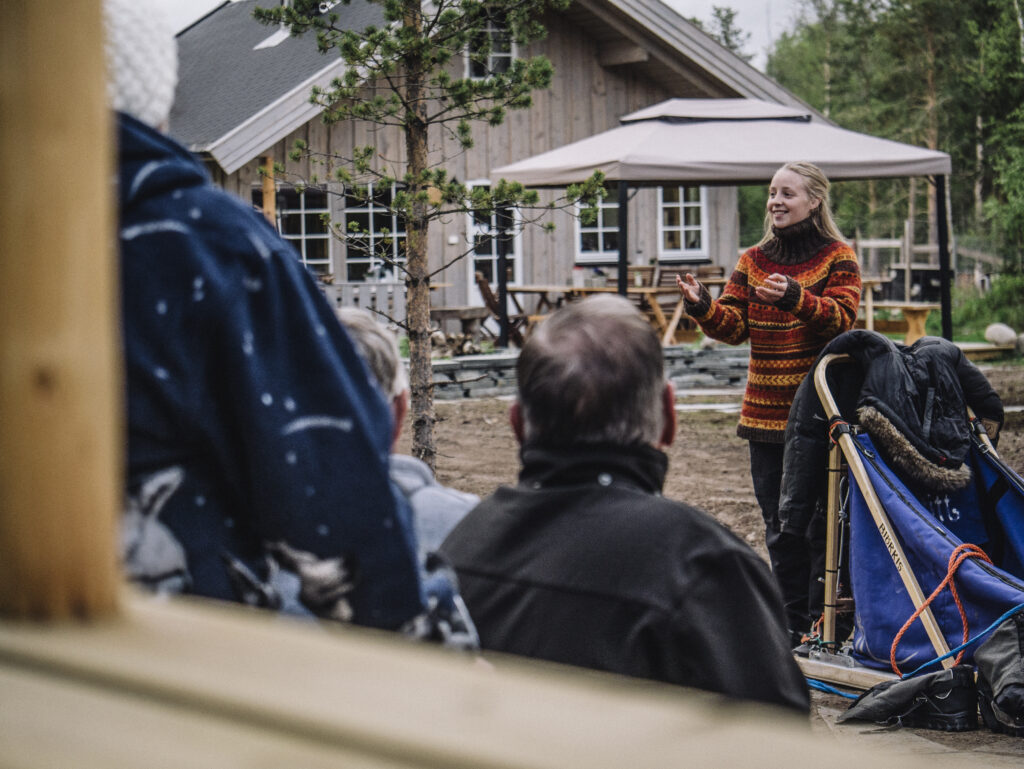
For Trasti & Trine, storytelling is therefore not an addition to the experience. It is part of the hosting itself. When we tell stories, we do not only aim to entertain, but to open space for understanding. Stories can make us laugh and smile, but they can also provoke wonder, self-reflection and a desire to question our own practices. At their best, a story can provide learning, new perspectives and perhaps even inspire change.
This applies to every aspect of what we do. In our food we tell stories through ingredients, craft, flavours and the people behind them. Each dish comes from a place, from a season, from a choice and from hands that have worked on it. When the story accompanies the food to the table, the meal becomes more than something you eat. It becomes an entry point to the place, the nature and the people who made it possible.
The same goes for outdoor experiences. A dogsled ride, a hike, an encounter with darkness, light or silence becomes more powerful when the guest understands the context of what they experience. The story gives the landscape depth. It gives the animals value beyond the activity. It gives the guest an opportunity to understand that nature is not a backdrop, but a living part of the whole we all stand within.
For us, storytelling must always be linked with action. Words lose power if they are not reflected in how we work. Therefore the stories we tell must be recognizable in the choices we make, in the ingredients we use, in the relationships we build, in how we welcome guests and in the responsibility we try to take for the place around us. Storytelling is not about embellishing reality, but about making reality clearer.
Through Forkprint we see storytelling as a social responsibility. It's about passing on knowledge, highlighting people, making connections visible and creating respect for the nature we live in, with and from. When stories are shared with honesty and presence, they can bring people closer to each other, to their community and to nature.
This is how experiences become memories. Not just because something was beautiful, good or different, but because it made sense. Because the guest moved on with a feeling, a thought or a question that lasts longer than the visit itself.